The past few years have tested school boards on every front: cybersecurity and AI governance, school choice and enrollment shifts, polarized debates over curriculum and inclusion, and constant regulatory change at the state and federal level.
Through it all, boards have continued to innovate, steady their districts and keep students at the center of every decision.
What’s ahead for 2026? To find out, we asked education leaders what’s really on school boards’ minds for the year ahead.
Their answers paint a clear picture: 2026 is the year boards shift from short‑term crisis response to long‑range, strategic governance.
Below, we unpack the top trends shaping K‑12 governance in 2026 — and what your board can do now to prepare.
2026 trends for school boards
1. From recovery to acceleration: Student success stays at the center
Post‑pandemic “learning loss” conversations are giving way to a longer‑term focus on learning acceleration and durable student growth. Districts are moving beyond remediation to redesigning instruction and supports around what works best for each learner.
According to our experts, school boards in 2026 will be focused on:
- High‑impact tutoring and evidence‑based instruction as core levers for long‑term improvement, not temporary interventions.
- K–3 literacy reforms, as more states adopt new laws and guidance on early reading, curriculum and teacher training.
- Integrated MTSS that braids together academic, behavioral and mental health supports instead of treating them in silos.
- Equitable outcomes across student groups, with boards demanding data that shows who is benefiting — and who isn’t.
What this means for your board in 2026
- Tie every strategic goal to clear, measurable student outcomes and ask for regular progress monitoring updates.
- Use trend data — not just one‑year snapshots — to guide decisions about programs, staffing and funding. For a deeper dive into budget decisions driven by data, explore expert tips for leveraging data for school board budgets.
- Make sure your board packet technology makes longitudinal student and financial data easy to access, compare and discuss.
2. AI, technology and future‑ready learning move from pilots to policy
AI governance has been on the agenda for the past couple of years; in 2026, it becomes unavoidable. Boards are being pushed to move from “watching the trend” to setting clear boundaries and expectations.
Our experts see several priorities emerging:
- Developing AI governance frameworks that define ethical use, protect student data and clarify acceptable uses for staff and students.
- Integrating AI tools to reduce teacher workload (e.g., drafting communications, building lesson ideas, analyzing data) while safeguarding professional judgment.
- Expanding career pathways, STEM/STEAM, computer science and work‑based learning so students graduate with future‑ready skills.
- Updating technology infrastructure to support 1:1 devices, secure networks and meaningful digital literacy — not just access.
- Defining the graduate profile your community wants, then aligning curriculum and assessment to that vision.
- Implementing smartphone policies as more states tighten rules and districts shift from debating “whether” to problem‑solving “how.”
Make AI risks less risky
Tackle compliance, ethics, and public trust with a kit built for public sector boards and councils.
3. Safe, supportive and inclusive school environments under pressure
Creating safe, supportive and inclusive school climates remains a top priority and a moving target in 2026. Experts highlighted several intertwined challenges:
- Rising student mental health needs, and the cost and complexity of staffing counselors, social workers and prevention programs.
- Systematic work on belonging, climate and culture, supported by surveys, listening sessions and dashboards that track progress over time.
- Evolving safety and threat‑assessment protocols, as federal and state guidance continues to shift.
- Managing behavioral escalation while maintaining fair discipline, restorative practices and adequate staff support.
- Ensuring compliance with changing equity and inclusion regulations, including protections for LGBTQ+ students and students with disabilities.
What this means for your board in 2026
- Ask for climate data alongside academic data — and use it to inform resource allocation.
- Ensure policies on behavior, bullying and discrimination are up to date, clearly communicated and consistently implemented.
- Use your board portal to centralize safety plans, compliance checklists and crisis communication so leaders can act quickly.
4. Financial stewardship in an era of enrollment shifts and higher needs
The financial picture in 2026 is complex: declining birthrates and increased school choice are reshaping enrollment even as needs and expectations grow. Andrea Messina, CEO of the Florida School Board Association, underscores that any discussion of enrollment decline must include demographic trends and the rapid expansion of choice options across the country.
Districts are also grappling with:
- The ESSER cliff aftermath and what happens once pandemic‑era federal funds are gone.
- The rising cost of special education and auxiliary services, which Dr. Audrey Young, member of the Texas State Board of Education, flags as a major concern for 2026.
- Superintendent evaluations tied to financial performance and the pressure that comes with failing to control spending.
- Greater focus on bond elections, capital planning and “rolling over” bond capacity to keep facilities viable without shocking taxpayers.
Boards that succeed will link every dollar to the strategic plan — and communicate clearly with their communities about the trade‑offs involved.
5. Talent, workforce and organizational health: The human side of strategy
Teacher and staff shortages are not new, but 2026 will force boards to treat talent strategy as core governance, not just HR’s job.
Board member training is equally critical, particularly as boards take on a more active role in talent strategy, workforce oversight, and organizational health.
Key areas include:
- Recruitment and retention that goes beyond pay to include workload, recognition, career pathways and culture.
- Grow‑your‑own educator pipelines and deeper partnerships with universities and alternative certification providers.
- Sustainable compensation and benefits that balance competitiveness with long‑term fiscal responsibility.
- Strengthening leadership pipelines for principals, assistant principals and central‑office leaders — not just superintendents.
- Intentional work on staff climate and organizational health, backed by data and board‑level accountability.
6. Governance excellence and community trust in a polarized era
How boards govern will matter as much as what they decide in 2026. As expectations rise and public scrutiny intensifies, alignment across the board–superintendent team is a recurring concern — and a critical determinant of whether districts can move from reactive decision-making to sustained, strategic leadership.
Steve Schroeder, Director of Administration & Analysis at the Association of Wisconsin School Administrators and former board president in Sun Prairie, Wisconsin, highlights several governance themes:
- Moving from operational to strategic governance, with clearly defined roles for the board and superintendent.
- Updating board policies on AI, data privacy and social media obligations as new technologies and regulations emerge.
- Regular board self‑evaluations and governance goal‑setting so boards model continuous improvement.
- Proactive, transparent community engagement through listening sessions, advisory councils and accessible dashboards — rather than reactive crisis communication.
“Boards need to move from operational to strategic governance. That means clarifying roles with the superintendent, updating policies on AI and data privacy, and engaging the community proactively through listening sessions and dashboards — not just when there’s a crisis.”
— Steve Schroeder, Director of Administration & Analysis, Association of Wisconsin School Administrators and former board president, Sun Prairie School District
7. Facilities, enrollment and long‑range planning
Facilities and enrollment planning may feel technical, but they’re increasingly central to long‑range strategy. Experts see boards focusing on:
- Modernizing facilities and designing flexible learning spaces that support collaboration, technology integration and specialized programs.
- Tracking demographic trends closely and making decisions on boundary adjustments, school consolidations or grade reconfigurations.
- Ensuring facilities can support CTE, STEM and hands‑on learning, not just traditional classrooms.
- Weighing sustainability investments — from energy efficiency upgrades to carbon‑neutral goals — against competing capital needs.
These decisions are inseparable from finance, community trust and student experience, making them ideal for board study sessions and multi‑year planning.
8. Legal compliance, cybersecurity and risk management: The stakes keep rising
The legal and regulatory landscape for K‑12 is only growing more complicated. Boards face a crowded docket:
- Ongoing changes in Title IX, special education guidance and teacher licensing rules.
- New or expanded state laws on curriculum transparency, parental rights, public records and data privacy.
- An elevated cyber threat environment, with K‑12 remaining a high‑value target for ransomware and data breaches.
To manage these risks effectively, boards should ensure that data access is carefully controlled, roles are clearly defined and secure technology platforms support compliance and collaboration. Modern solutions can help minimize human error, enforce permissions and maintain regulatory standards, all while making critical information available to the right people at the right time.
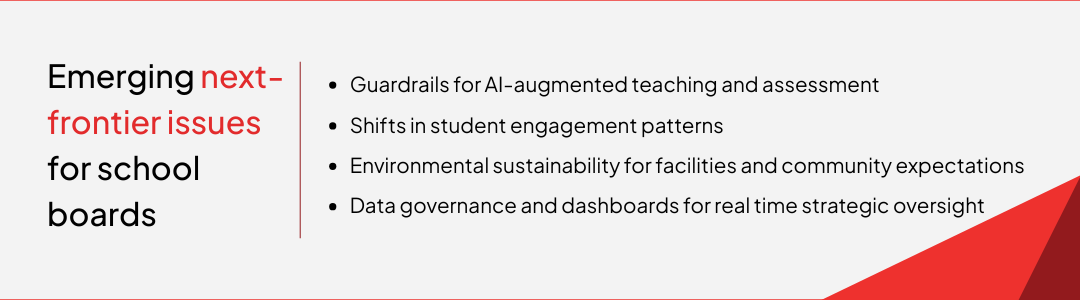
Be ready for anything in 2026 and beyond
If the last few years have taught school boards anything, it’s that change is constant. What doesn’t change is your core mission: delivering a high‑quality education for every student in every community you serve.
To lead in 2026, boards need clear shared goals, reliable real‑time data and secure modern tools to manage meetings, policies, training and community communication.
Diligent Community is purpose‑built for public sector boards — including school districts — to help you run efficient transparent meetings, collaborate on policies, manage data securely and keep your community informed from a single platform.
Book a demo to see how it can help your board lead with oversight, insight and foresight in 2026 and beyond.