

In this article

Angel investors aren't smaller versions of venture capitalists. They evaluate differently, move faster and care about different things. Yet most pitch deck guides treat every investor type as interchangeable. If you're a founder or CEO at a growing company preparing to raise an angel round, that generic advice can lead you astray. You end up building a deck calibrated for Series A partners, only to present it to angels who evaluate it through an entirely different lens.
The distinction matters because angels are often former founders themselves. They're investing their own money, making individual decisions and assessing whether you can execute, not whether your financial model survives a 47-tab stress test. Your deck needs to reflect that reality.
This guide covers everything you need to build an angel-specific pitch deck and run a professional fundraising process:
The structural economics of how angels and VCs operate are fundamentally different, and that changes almost everything about what belongs in your deck.
Angels write smaller checks. Individual angels often invest in the tens of thousands of dollars, while angel groups invest in the range of angel group checks. Series A rounds, by comparison, are typically in the multi-million-dollar range (and vary significantly by market and year) as shown in Crunchbase's Series A distribution. That gap means your angel round will aggregate dozens of individual investors, each making independent decisions. So your deck needs broad appeal across varying levels of expertise.
Angels also move faster. Initial responses typically come within one to two weeks, and the overall process is compressed compared to Series A timelines of four to twelve weeks plus extended due diligence. Your deck must facilitate a fast initial assessment. Every slide needs to stand on its own because multiple angels will read your materials separately at different times.
Most importantly, angels evaluate through an operator lens. Former-founder angels are increasingly common, and they prioritize founder conviction, domain expertise and early proof points over polished financial models. They're asking "Can this person execute?" not "Does this spreadsheet hold up under 47 scenarios?" That means your team slide and traction slide carry more weight than your financial projections.
The implication is, if you're recycling a VC-oriented template for angel conversations, you're answering questions angels aren't asking while leaving their real concerns unaddressed.
The best angel decks answer one specific investor question per slide, in the order investors naturally ask them. This structure aligns well with frameworks like the Sequoia guide. Stay under 13 slides for email decks to under 13 slides and live presentations to under 15. Here are the 10 slides that matter most.
Your cover answers the simplest question: "What is this company?" Define your company in a single declarative sentence. This is harder than it looks. It's easy to get caught up listing features instead of communicating your mission." Include your company name, logo and one declarative mission statement. Optionally add a single credibility signal like your current ARR or a notable advisor. Resist the urge to clutter the cover with product screenshots or bullet lists.
This slide answers "Why should I care?" and it's where most decks fail. Structure it in three parts: the customer's specific pain point, how they address it today and the explicit shortcomings of current solutions. Use your customers' actual language here. You've talked to hundreds of them. A quantified pain point like "CFOs at growing companies spend 12 hours per week on cash flow reporting" lands harder than abstract problem statements.
Present the breakthrough insight that makes your approach different, not a feature list. Describe what your product does in clear, non-technical terms. Explain why the advantage endures (defensibility). Use visuals, mockups, workflow diagrams or screenshots instead of text blocks. The distinction matters: "We use machine learning to..." is a feature description. "The insight no one has acted on is..." is a eureka moment.
Angels fund entry strategies, not market sizes. That's why market sizing guidance puts equal pressure on the narrative of how you win, not just how big it is. Use both top-down and bottom-up calculations for your total addressable market, serviceable addressable market and serviceable obtainable market, and show they're consistent. Ground your sizing in customer conversations: "We've spoken to 200 potential customers; 40% have this problem acutely; at our price point, that represents a $180M SAM in our first vertical" is infinitely more credible than citing an industry report with a $50 billion headline number.
Show your revenue model, pricing strategy and, critically, your actual unit economics. With real revenue behind you, present your real customer acquisition cost, lifetime value and gross margins rather than projections. One focused, validated revenue model beats multiple unvalidated revenue streams every time.
This is your single most powerful slide as a growing company with real revenue. Lead with your revenue trajectory, MRR or ARR growth over time, followed by customer count, retention rates, notable logos and growth velocity. If your numbers are strong enough, consider moving this slide earlier in the deck.
Show week-over-week or month-over-month growth trends, not just cumulative totals; for seed-stage contexts, Y Combinator explicitly notes that sustained high growth velocity (e.g., around 10% week-over-week) is "impressively rapid," and the broader point translates: velocity matters. Leave out vanity metrics like raw downloads or page views that don't correlate with revenue.
Angels invest in people first. Tell the story of your founders, not list credentials. Every point on this slide should answer why this specific team is uniquely qualified to win this specific opportunity. Highlight relevant industry experience, complementary skills across co-founders, domain expertise and evidence of execution such as previous companies built. If you have notable advisors or board members, include them. Generic bios that don't connect credentials to your specific challenge waste the slide.
Address both direct and indirect competitors with a clear plan to win. Feature comparison matrices showing specific advantages work well, but the core requirement is articulating your competitive moat: network effects, switching costs, proprietary technology or distribution advantages. Never claim you have no competitors. Experienced angels universally interpret that as poor market knowledge.
State the exact amount you're raising. Never give a range. Include a visual breakdown of how the capital deploys across categories like product development, sales, team and operations. Then connect that deployment to three or four concrete milestones: "We'll use this capital to reach $X ARR and achieve Y retention, positioning us for a Series A at Z valuation."
A clear ask backed by organized documentation demonstrates the operational readiness angels need to see. Burying a vague ask on the final slide signals either poor planning or lack of confidence. Neither interpretation helps you.
Paint the five-year vision. This is not a financial projection but a picture of category leadership. What will you have built? What customer impact will you have at scale? Close with direct contact details and a clear call to action for next steps. Make it easy for interested angels to reach you immediately.
These are the mistakes angels notice but rarely tell you about. You leave the meeting with a polite "we'll be in touch" and never learn why.
It’s also more common than most founders think for companies to run transactions with siloed information. According to the Transaction Readiness Report by Diligent Institute in partnership with Wilson Sonsini, NetSuite, CFO Alliance and CFO Leadership Council, only 4% of organizations have fully integrated GRC and financial systems.
Meanwhile, according to Diligent Institute and Corporate Board Member's What Directors Think 2026 survey, 53% of directors say they don't often receive real-time data between meetings, highlighting how common information gaps are even at the board level.
"One of the clearest gaps I notice is between governance and finance systems... Organizations that close this gap gain speed, credibility, and control in transactions," says Jack McCullough, Founder and President of the CFO Leadership Council.
The takeaway is, if you can present a single, well-organized source of truth (financials, approvals, key contracts, cap table and risk/compliance documentation) and respond quickly, you’ll stand out from the disorganized majority—and you’ll remove friction from an angel’s decision to lean in.
The deck is necessary but not sufficient. How you run the fundraising process often matters more than any individual slide.
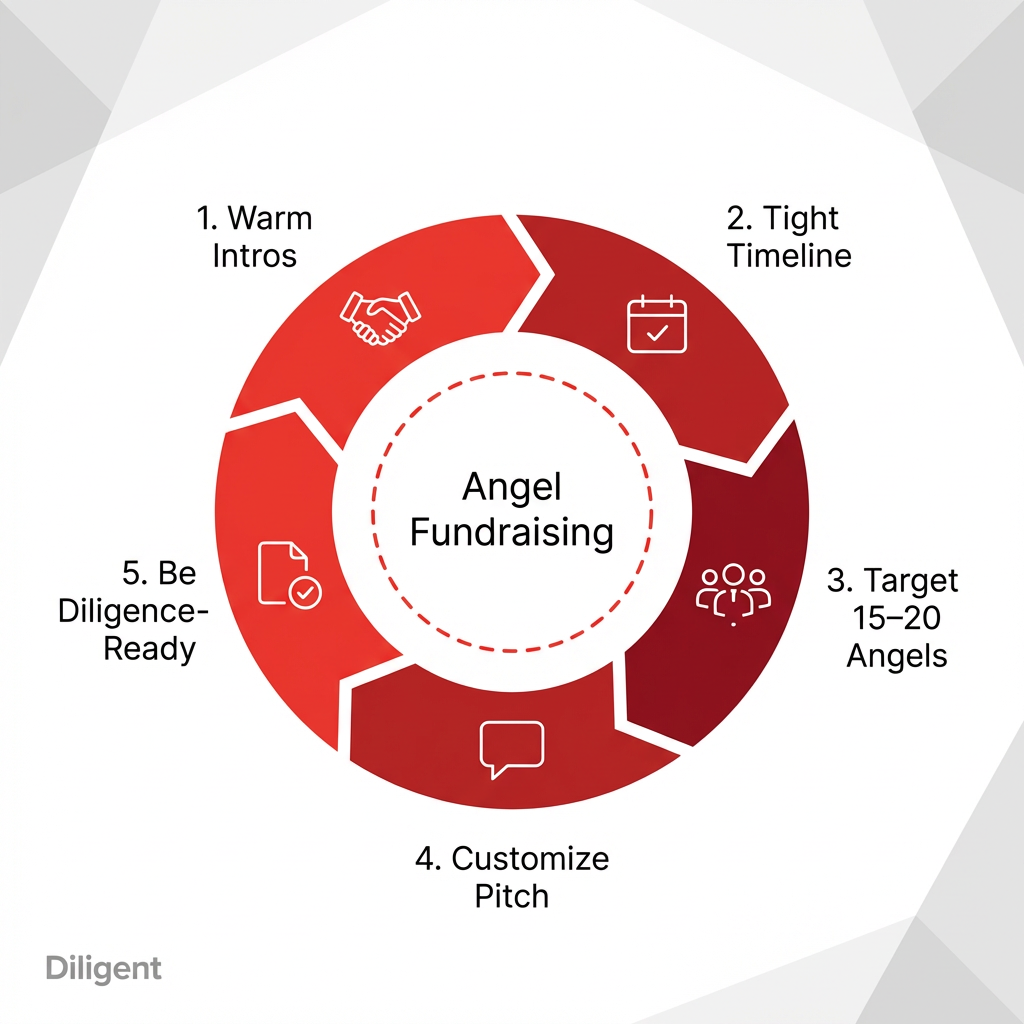
Here are practical ways to run an angel process that creates momentum:
At the scale of 15 to 20 parallel conversations, track each conversation's stage, next actions and documents shared systematically. Send monthly updates to all active investors simultaneously to keep everyone informed without requiring individual check-ins.
Discover how AI transforms board preparation and decision-making for growing companies.

Growing companies raising angel rounds face three persistent problems: creating professional investor materials without dedicated staff, organizing due diligence documents under time pressure and catching compliance gaps before an angel's legal counsel finds them during diligence. Diligent's platform addresses these problems with:
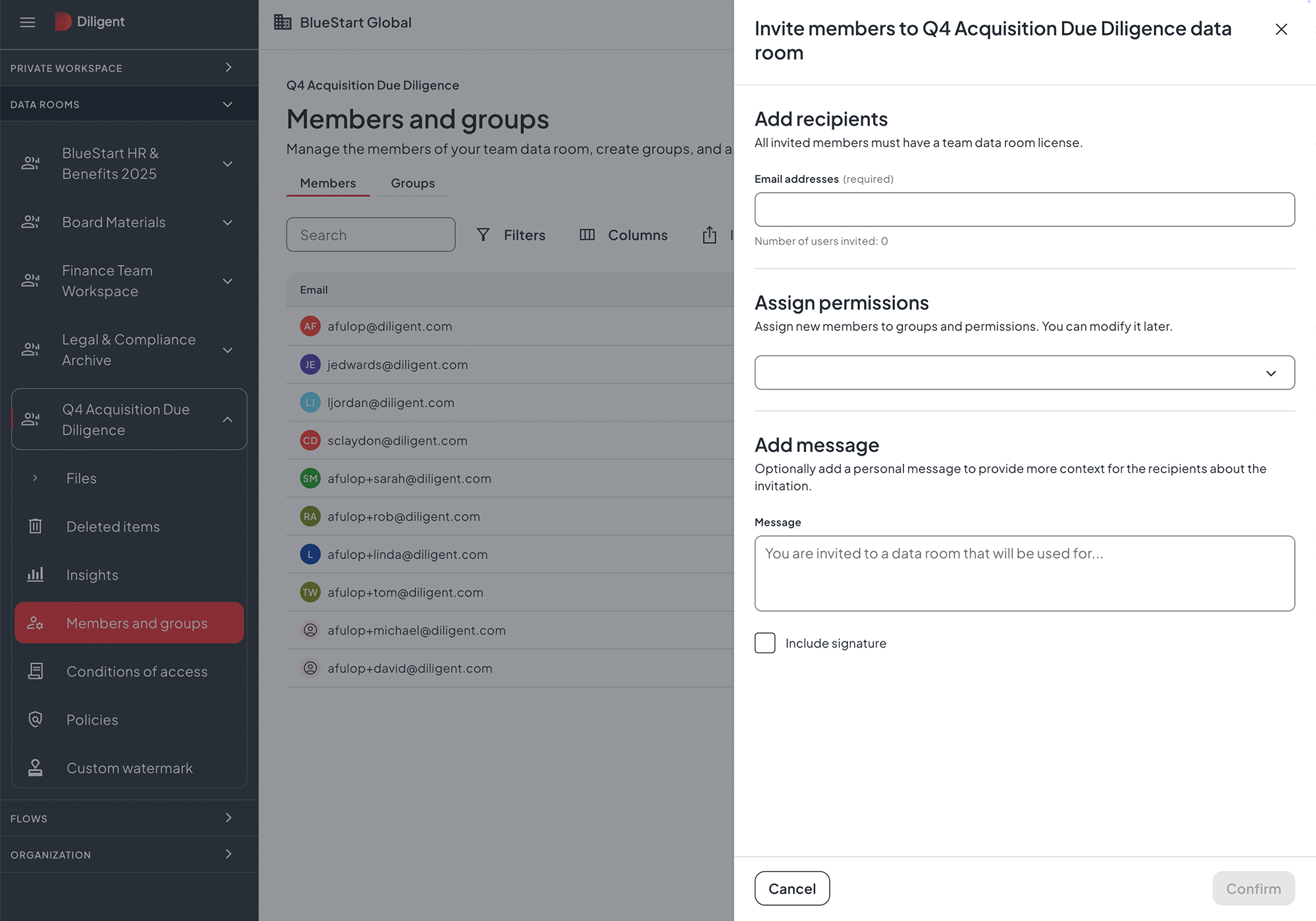
For resource-conscious teams, speed-to-value matters as much as features. Growing companies need solutions that are quick to deploy and simple to learn when they're standing up investor-facing governance and diligence workflows without adding headcount.
The critical advantage is how all three work together on a unified platform: Documents move from secure storage through material creation and automated risk review without manual transfers or format conversions.
The angel round isn't just a funding event. It's your first governance inflection point. The habits you build here, organized materials, clean documentation, professional investor communication, compound through every future raise. The documentation practices you establish during angel fundraising, organized data rooms, clean cap tables, systematic investor updates, become the operational foundation for Series A readiness.
Companies that demonstrate institutional-grade governance documentation during due diligence consistently command better terms. Angels who join early and experience professional governance from the start become advocates in later rounds, providing warm introductions and signaling credibility to Series A investors evaluating your deal.
Growing companies that treat the angel round as a governance milestone, not just a cash event, compress their path to Series A. The infrastructure you build now scales with you through growth rounds and eventual exit, turning what feels like administrative overhead into a lasting competitive advantage.
Build your investor-ready foundation today. See how Diligent helps growing companies organize governance, streamline due diligence and stay fundraise-ready from angel round to exit. Request a demo
Aim for under 13 slides for email decks that will be read without you present and no more than 15 for live presentations. Successful angel decks like Intercom's used as few as 8 slides, while Onyx raised $10 million with just 9. Each slide should answer one specific investor question. If a slide doesn't move the angel toward yes, cut it.
Angel decks emphasize founder conviction, growth velocity and traction over detailed financial models. Angels invest their own money in smaller checks with faster decision timelines, so they evaluate through an operator lens rather than a fund-returner lens. VC decks require deeper unit economics, cohort analysis and scalability documentation that angels generally don't expect at this stage.
Show your actual unit economics, customer acquisition cost, lifetime value and gross margins, rather than elaborate five-year projections. Angels know early-stage projections will be wrong. They're evaluating whether you understand your business drivers and can explain your assumptions clearly. A directional three-year picture with clean assumptions is more credible than a 47-tab financial model.
Have your data room organized and access-ready before the first meeting. When an angel expresses interest, grant secure access to supporting materials, financials, the cap table, customer contracts, and compliance documentation within hours. Send monthly updates to all active investors simultaneously, covering key metrics, recent wins, honest acknowledgment of challenges and specific asks.
Traction and team. Angels index heaviest on evidence that the business is working, revenue growth, customer retention and engagement metrics, and on whether the founding team is uniquely qualified to execute on this specific opportunity. A compelling traction slide paired with a strong team narrative is more persuasive than any other combination of slides.
Ready to stay investor-ready from your first angel check to exit? Explore Diligent.




