
In this article

Agenda management is the foundation of effective board governance, yet most corporate secretaries spend weeks preparing for meetings that still drift into operational weeds. Research from the Chartered Governance Institute reveals that 54% of board members describe finding key messages in their materials as challenging, while the average board pack has grown to 226 pages. The result: directors arrive overwhelmed, critical decisions get deferred and meetings focus on presentations instead of strategic discussions.
According to the 2026 What Directors Think report by Diligent Institute and Corporate Board Member, 58% of directors want more time dedicated to strategic planning, while 42% want fewer presentations and more discussion. Yet 53% say they don't often receive real-time data between meetings, making effective agenda management critical to achieving the strategic focus boards seek.
This guide covers everything you need to know about agenda management and board meeting optimization:
Agenda management encompasses the systematic planning, development and execution of board meeting agendas to ensure productive governance outcomes. It extends beyond simply listing discussion topics to include strategic prioritization, stakeholder coordination, material preparation and meeting facilitation.
Effective agenda management determines whether board meetings serve as strategic governance forums or devolve into operational reporting sessions. When done well, it enables directors to focus their limited time together on the decisions that matter most.
The discipline involves several interconnected processes:
Well-structured agendas directly impact governance quality across several dimensions:
Research from the APAC Governance Outlook 2026 report by Diligent Institute, Governance Institute of Australia and Singapore Institute of Directors found that 63% of boards want more time for strategic discussions, echoing findings from What Directors Think 2026, where "strategic planning" topped the list of issues directors consider most pressing to discuss at their next board meeting.
When agenda management fails, these aspirations remain unfulfilled as meetings consume time on presentations that directors could have reviewed in advance.
"Giving the information in advance helps board members better prepare. They can also go back to previous meetings, and if they have questions on what was discussed previously, they can review it easily. We also share the draft agenda before it's published to help show them what's going to be discussed at the meeting," says Catherine Hill, Executive Secretary at Vigo County School Corporation.
This framework transforms board preparation from reactive scrambling into a repeatable workflow. Each step builds on the previous one, creating infrastructure that improves with every meeting cycle.
Professional board governance starts with annual planning, not reactive scheduling. Ideally, board calendars should be set months before the fiscal year, with meeting dates locked 12 months in advance. This demonstrates organizational maturity and ensures that directors protect time for your meetings.
Begin by identifying your organization's strategic planning cycles. When does the executive team conduct annual planning? When do funding rounds typically close? When do audit committee requirements demand board attention? These business rhythms should dictate the board calendar rather than arbitrary quarterly intervals.
Map recurring compliance requirements across the governance year, then categorize activities by strategic oversight, fiduciary duties and board development.
Create a calendar communication template that includes the following for each meeting:
This template becomes your governance roadmap for the year.
Communicate the finalized annual calendar to board members and key stakeholders immediately upon approval, giving directors adequate time to plan around your meetings.
The most common governance mistake is treating agenda development as administrative rather than strategic. Agenda-setting should involve the board chair, CEO and key executives to align with strategic priorities.
Begin your agenda development process three to four weeks before each meeting. This timeline demonstrates governance maturity to potential investors and allows adequate time for stakeholder input and material preparation.
Solicit agenda item proposals using standardized templates that require a brief justification for new items. A well-designed board meeting agenda template ensures consistency across meetings while prompting contributors to address the right questions: What strategic topics require board deliberation this quarter? What emerging risks need board oversight? What compliance matters require formal approval? What opportunities should the board evaluate? What decisions can wait until the following meeting?
Apply the "Jar of Life" prioritization principle: strategic decisions are the large "rocks" that must go in first, with routine updates as "sand" filling gaps. Schedule strategic priorities early in meetings when director attention is freshest.
Clear deadlines prevent chaotic final days when governance professionals scramble to compile incomplete information. Materials should have submission deadlines days before meetings, giving adequate time to compile materials, conduct quality reviews and distribute the board book.
Establish standardized submission templates for all board materials. Templates eliminate formatting inconsistencies while reducing executive preparation time by enforcing required structure. Your template should mandate specific elements:
When executives miss submission deadlines, materials may not meet quality standards before distribution. Enforce deadlines consistently to maintain professional standards and protect the overall timeline.
Structure every agenda item with five essential elements that prevent confusion and keep directors focused on decisions:
Additionally, frame agenda items as strategic questions rather than topic labels. Instead of listing "Q3 Financial Results," pose "What strategic implications do Q3 results have for our market positioning?" This question-based framing maintains strategic focus and facilitates more productive deliberation.
Board books should be assembled several days before meetings with a quality assurance review. Execute this process systematically using a pre-distribution checklist:
Organize your board book to match the agenda flow exactly, ensuring directors can navigate from agenda item to corresponding materials without searching. For digital board management platforms, create clear folder structures using consistent naming conventions that mirror the agenda sequence.
Materials should be distributed at least seven days before meetings, allowing directors to review thoroughly, formulate strategic questions and prepare for substantive discussion. After distributing materials, proactively reach out to board members several days before the meeting.
A brief communication asking whether they have questions serves two purposes: it confirms they've accessed the board book and allows management time to prepare thorough responses rather than improvising answers during the meeting.
Meeting execution is where preparation work either pays dividends or unravels. Board time should prioritize strategic discussions and governance oversight rather than information presentation.
Start meetings by approving your consent agenda through a single motion. Any director can request the removal of items for separate discussion — all remaining items receive approval together. This efficiency creates time for strategic topics that actually benefit from board deliberation.
Also, eliminate lengthy presentations in favor of substantive discussions. Directors reviewed your materials — they don't need executives reading slides aloud. Use discussion-starting phrases: "Since you've reviewed the materials, let me highlight what's changed in the past week..." or "Rather than walking through the deck, I'd like to start with the three key decisions we need your input on..."
"Most board meetings become the staff talking more than board members. We flipped that. All the presentations are recorded ahead of time, so board members have to watch the video and do their homework. This has forced board members to prepare and engage at the meeting. It has also cut down the board meeting time," says Steve Schroeder, Board Member at Sun Prairie Schools.
When discussions run over, the board chair should acknowledge the importance of the topic while suggesting it be continued at a future meeting or through a follow-up communication. Strategic items deserve adequate time, but not at the expense of other agenda priorities.
And when off-agenda items arise, acknowledge the concern, assess genuine urgency, then either schedule it for future discussion or document it in a "parking lot" for follow-up. Only in rare cases of true urgency should you consult the full board on whether to address items immediately.
Assign someone to capture action items in real time, documenting clear ownership and deadlines. This systematic documentation prevents the common governance problem where everyone agrees something should happen, but no one takes ownership.
Post-meeting follow-up determines whether board decisions actually drive action. Meeting minutes should be prepared and distributed promptly after meetings to capture decisions while discussions remain fresh.
Draft minutes immediately after meetings while your notes are clear and your memory is sharp. Waiting even a few days introduces ambiguity about what was actually decided versus what was discussed. Your minutes should clearly document decisions made, rationale for those decisions, action items with ownership and deadlines and any directors who abstained or dissented.
Additionally, send executives their assigned action items immediately after the meeting while momentum is high. Review action item status at each executive team meeting and include an action item status report in the next board book so directors can see that their decisions are being implemented.
Finally, conduct annual evaluations that assess meeting management across the full governance cycle. Calculate strategic time allocation metrics, tracking the percentage of board meeting time devoted to strategy versus compliance.
Download the board meeting preparation checklist to streamline agenda development and ensure nothing falls through the cracks.

Traditional agenda management requires manual coordination across multiple stakeholders, version control challenges and significant time investment. Board management technology addresses these pain points through integrated capabilities that streamline the entire meeting lifecycle.
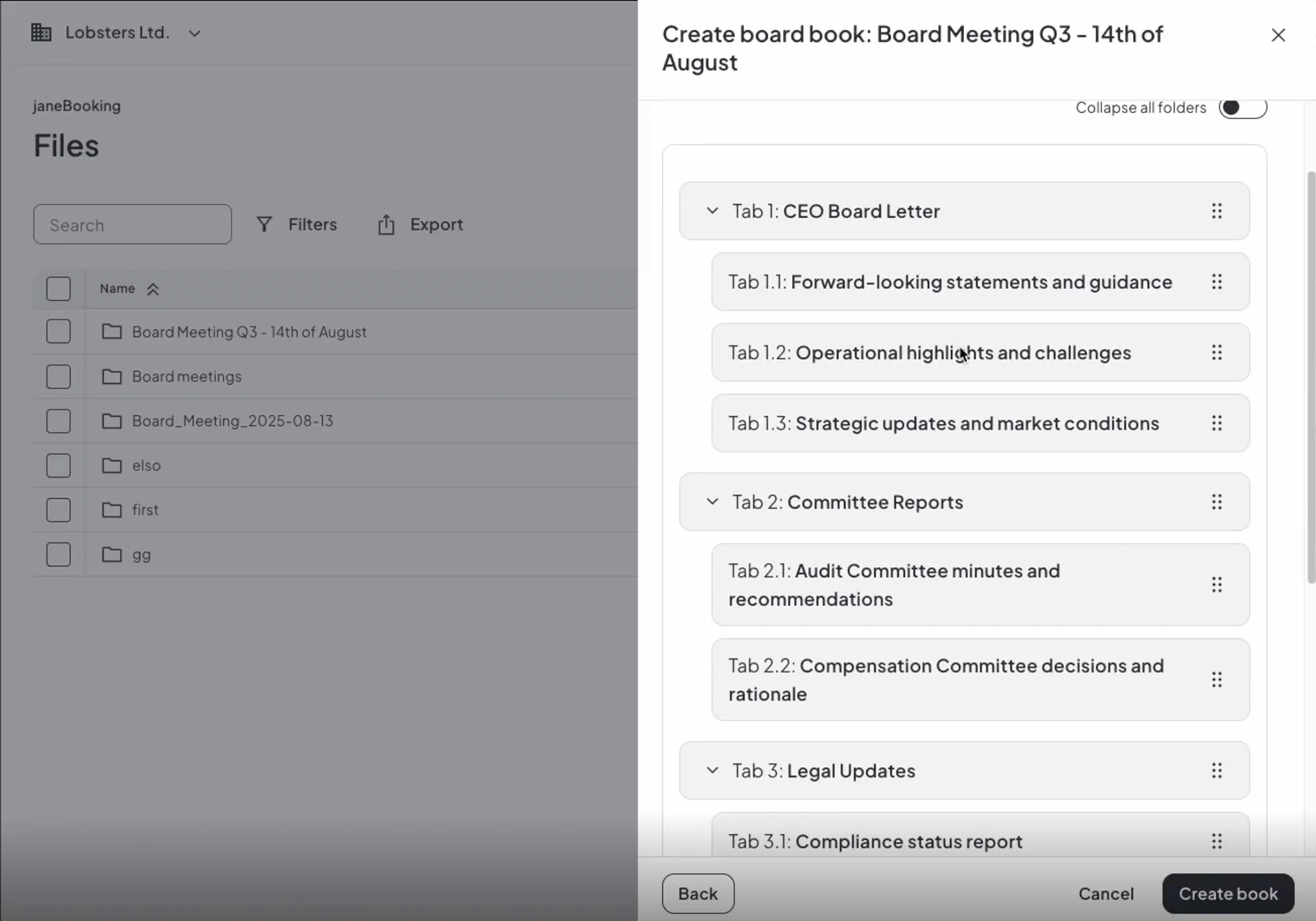
For example, the Agenda Builder feature within Diligent Boards transforms agenda management through intelligent capabilities that reduce manual rebuilding. Intuitive tools allow contributors to securely access and edit documents in real time, ensuring board members always have the latest updates. Drag-and-drop functionality makes it easy to customize agendas, copy previous meeting structures and track discussion points.
"Our platform [Diligent] has revolutionized how we access information, creating a seamless system of checks and balances across our committees. Before using this platform, we relied on disorganized systems, but now everything is streamlined on one platform, allowing us to manage our operations effortlessly. Features like real-time updates and easy document management have streamlined our operations, making our meetings more effective and efficient," says Bing Goldsworth, Executive Assistant at Organically Grown Company.
Building on the above, Smart Builder, Diligent's AI-powered tool for creating board materials, helps governance teams build professional board books faster by leveraging templates and proven structures. Rather than rebuilding materials from scratch for each meeting, governance teams can leverage proven structures and adapt them for current priorities. This reduces preparation time significantly while improving material quality and consistency.
These efficiency gains are already playing out in practice. ELCO Mutual Life and Annuity, an insurance and financial services provider with more than 75 years of history, adopted Diligent Boards and GovernAI to modernize legacy board processes. Board-meeting preparation dropped from a full day or two to roughly one to two hours, and AI-powered features like set time limits for agenda items helped cut Executive Committee meetings from two and a half hours to an average of 30 minutes.
Additionally, action item tracking displays progress on commitments from previous meetings. This historical visibility allows administrators and board members to see action item status when building subsequent meeting agendas, ensuring commitments don't fall through the cracks while enhancing accountability across the governance team.
For organizations managing multiple committees and complex meeting schedules, these integrated capabilities provide the infrastructure needed to maintain governance quality without proportional increases in administrative effort.
Ready to transform your board agenda management? Schedule a demo to see how Diligent Boards with Agenda Builder streamlines meeting preparation from start to finish.
Most effective board agendas contain 8-12 items, though the appropriate number depends on item complexity and meeting duration. Rather than counting items, focus on time allocation: strategic discussions should consume 60-70% of meeting time.
Use consent agendas to bundle routine approvals into a single vote, freeing time for substantive discussion. If your agenda regularly contains more than 15 items, evaluate whether some topics could be handled through written reports or delegated to committees.
Establish a clear protocol for off-agenda items. Acknowledge the concern and assess genuine urgency. True emergencies requiring immediate board action are rare — most "urgent" items can wait for the next scheduled meeting or be addressed through a written consent process.
Information items require directors to receive and acknowledge material without taking action. Discussion items invite director input and deliberation without requiring a formal vote. Action items require the board to make a decision, typically through a motion and a vote.
Clearly labeling each agenda item's purpose helps directors prepare appropriately and ensures meetings accomplish their intended objectives.
Virtual meetings require shorter agenda items with more frequent breaks to maintain engagement. Plan for 90-minute sessions maximum before breaks. In-person meetings can accommodate longer strategic discussions, but should still include designated break times.
Regardless of format, the fundamental agenda management principles apply: clear purpose designation, adequate material lead time and systematic follow-up. Virtual meetings may benefit from more structured facilitation to ensure all directors have the opportunity to contribute.
Agenda management software replaces manual coordination with integrated workflows that automate the entire meeting lifecycle. Features typically include drag-and-drop agenda building, automated material distribution, real-time collaboration on documents, action item tracking across meetings and searchable archives of past agendas and minutes.
For governance teams managing multiple boards or committees, these platforms eliminate version control issues and reduce the administrative hours spent assembling board books from days to minutes.
Request a demo to see how Diligent automates board meeting preparation.