
Behind many legal entities worldwide, there is a beneficial owner — a person who owns or controls a substantial share of a company, even if they aren't involved in that company's operations. Despite its prevalence, beneficial ownership stayed relatively out of the spotlight until major regulatory changes began reshaping the scene.
While the United States Treasury Department's Financial Crimes Enforcement Network (FinCEN) eliminated beneficial ownership reporting requirements for domestic U.S. companies in March 2025, other jurisdictions have intensified their requirements.
Singapore's Monetary Authority imposed S$27.45 million in total penalties on nine financial institutions for beneficial ownership compliance failures, demonstrating the high stakes involved.
This comprehensive guide will help you understand and navigate beneficial ownership compliance by explaining:
A beneficial owner is an individual or entity with a management or ownership stake in a company, even if that company is legally registered to another entity. The exact definition varies by jurisdiction, but identifying and managing beneficial ownership information is essential for:
The concept has gained prominence as regulators worldwide implement transparency requirements to combat financial crime and tax evasion. For enterprise organizations, beneficial ownership identification extends beyond basic compliance — it's essential for stakeholder due diligence, transaction preparation, and comprehensive risk management.
Understanding beneficial ownership becomes particularly complex for large organizations with sophisticated corporate structures. Different jurisdictions maintain varying thresholds, definitions, and disclosure requirements, creating a regulatory patchwork that multinational companies must navigate carefully.
Enterprise compliance teams face the challenge of maintaining consistent identification processes while adapting to jurisdiction-specific nuances and evolving regulatory frameworks.
Beneficial ownership in the U.S. has undergone dramatic changes in 2025. While the Corporate Transparency Act (CTA) initially required most companies to report beneficial ownership information, FinCEN issued an interim final rule in March 2025 removing requirements for U.S. companies and U.S. persons. However, foreign entities that register to conduct business in the U.S. still face reporting obligations.
The beneficial owner concept refers to the true, substantive ownership of an asset or property, even if the legal title is held by another entity. This distinction remains crucial for financial institutions conducting customer due diligence and for companies preparing for funding rounds or strategic transactions.
To be a beneficial owner in the U.K., an entity must either hold at least 25% of shares or voting rights in a company or have significant influence over it. Companies must maintain this information in their People with Significant Control (PSC) register, which serves as a public record.
The U.K. has maintained consistent enforcement of beneficial ownership requirements throughout recent global regulatory changes. Companies House continues to require comprehensive disclosure through annual confirmation statements and immediate updates when ownership structures change.
Ireland follows a similar framework to the U.K., but with distinct differences. Ireland recognizes individuals or entities that control or own, directly or indirectly, more than 25% of a company's shares or voting rights. Unlike influence-based criteria used elsewhere, Ireland focuses on quantifiable ownership and control metrics.
Irish companies must maintain internal registers of beneficial owners and report this information to the public Central Register of Beneficial Ownership, creating dual compliance obligations for companies.
Australia defines beneficial ownership as owning 25% or more of a company's shares or voting rights, whether directly or indirectly. The country also recognizes beneficial owners as those controlling company operations, creating broader criteria than purely ownership-based thresholds.
Australian companies in sensitive sectors face additional scrutiny, with some industries requiring disclosure at lower ownership thresholds of 20% or even 10% depending on the sector and security considerations.
The UAE defines a beneficial owner as a person or entity that owns or controls at least 25% of a company or has the power to appoint or remove directors. Companies operating in the UAE must report beneficial owners to relevant authorities, with specific requirements varying by emirate and free zone.
UAE regulations emphasize both ownership and control elements, requiring companies to consider voting arrangements, shareholder agreements, and other mechanisms that could provide effective control below the 25% threshold.
South Africa considers a beneficial owner anyone with a controlling interest in a company through shareholding, voting rights, or decision-making influence. This broad definition captures various forms of indirect control and influence beyond simple ownership percentages.
South African regulations focus particularly on the ultimate natural persons who exercise control. This requires companies to look beyond corporate shareholders to identify the individuals who ultimately benefit from and control business operations.
Beneficial ownership structures can be sophisticated. Understanding real-world examples helps clarify how these arrangements work in practice and why regulators focus on transparency requirements.
An individual can establish a trust that legally owns shares in a corporation. While the trust appears as the legal owner on company records, the individual who established and controls the trust is the beneficial owner. This structure is common in estate planning and wealth management, where individuals want to maintain control while achieving specific tax or succession benefits.
The trust arrangement allows the individual to receive dividends, influence major decisions, and ultimately benefit from the corporation's performance. At the same time, it creates a legal separation between personal ownership and corporate shareholding.
Complex international structures often involve offshore entities registered in jurisdictions like the Cayman Islands or British Virgin Islands. An individual might establish an offshore company that holds a majority stake in an operating company elsewhere. The offshore entity serves as the legal owner, while the individual who established and controls it is the beneficial owner.
This structure gained significant attention with the 2016 Panama Papers revelations, which exposed hidden beneficial ownership details for thousands of offshore corporations. The investigation revealed how public figures, including political leaders and business executives, used these structures to obscure their ultimate ownership and control of assets.
Two individuals might each hold 20% of a company's shares, but one allows the other to control their voting rights through a shareholders' agreement or proxy arrangement. In this case, the individual with voting control becomes a beneficial owner of 40% of the company's voting power, despite only legally owning 20% of the shares.
Mark Zuckerberg's control structure at Meta provides a well-known example of this concept. While he owns less than 14% of the company's stock, dual-class share structures give him effective control over the company, making him a beneficial owner with control disproportionate to his legal ownership percentage.
A person might hold a minority shareholding but secure special rights to appoint or remove key executives, approve major decisions, or access sensitive information. These control mechanisms can establish beneficial ownership even when ownership percentages are below typical thresholds.
Beneficial ownership often extends through family relationships. If a spouse holds significant shares while their partner manages business operations or has informal influence over decisions, both individuals might be considered beneficial owners under various regulatory frameworks.
These arrangements require careful analysis because the relationship between legal ownership and beneficial interest may not be immediately apparent from corporate records alone.
Beneficial ownership reporting requirements emerged to promote transparency and combat illicit activities like money laundering and tax evasion. However, the regulatory landscape has become increasingly complex and variable across jurisdictions.
The regulatory environment in the United States experienced a dramatic reversal in 2025. While the CTA was initially designed to prevent money laundering, tax evasion, and terrorism financing by requiring most companies to report beneficial ownership information, FinCEN eliminated these requirements for domestic U.S. companies in March.
Current Status: Domestic U.S. companies and U.S. persons are no longer required to file beneficial ownership information. However, foreign entities registering to conduct business in the U.S. may still face reporting obligations.
Historical Context: Before the regulatory change, companies would have needed to disclose beneficial owners' names, birth dates, addresses, and identification numbers, with significant civil and criminal penalties for non-compliance.
The 5AMLD maintains stringent beneficial ownership requirements across EU member states to enhance financial transparency. The directive requires companies to maintain current beneficial ownership information in accessible central registers.
Requirements: Companies must report beneficial ownership information to central registers, which often become public information accessible to authorities and, in many cases, the general public.
Enforcement: Non-compliance can result in substantial fines and sanctions, with penalties varying by member state but generally including both financial penalties and operational restrictions.
The EU addresses beneficial ownership through corporate responsibility frameworks in the CSDDD. This directive requires companies to disclose beneficial owners as part of broader due diligence on sustainability and responsible business practices.
Requirements: Companies must disclose beneficial owners alongside comprehensive supply chain due diligence. This creates integrated reporting obligations that connect ownership transparency with operational responsibility.
Enforcement: Individual EU member states establish enforcement mechanisms, typically including financial penalties and operational restrictions for companies failing to meet disclosure requirements.
The Financial Action Task Force (FATF) sets international standards for combating money laundering and terrorism financing through mandates like AML/CFT. These include beneficial ownership transparency requirements that influence national regulations worldwide.
Requirements: Financial institutions and designated non-financial businesses must identify and verify clients' beneficial owners. Countries must maintain accessible central registers or alternative mechanisms ensuring competent authorities can access beneficial ownership information.
Enforcement: Countries failing to comply with FATF standards risk being blacklisted or facing economic sanctions, creating significant pressure for effective implementation.
The U.K.'s ECCTA creates transparency requirements to prevent economic crime, particularly in real estate transactions. The act extends beneficial ownership disclosure beyond traditional corporate structures to include property ownership arrangements.
Requirements: Foreign entities owning property in the U.K. must register beneficial ownership details with Companies House, creating comprehensive visibility into international property investment structures.
Enforcement: Non-compliance can result in criminal penalties, including substantial fines and imprisonment, with enforcement actions targeting both entities and responsible individuals.
Download our whitepaper today and adapt swiftly to stay compliant and protect your reputation.

The process of filing beneficial ownership information varies by jurisdiction. Generally, though, companies must submit information to a central authority or registry. Here’s a step-by-step guide on how to file in key jurisdictions.
U.S. filing obligations have changed in 2025 with the elimination of most reporting requirements:
U.K. companies must file beneficial ownership information through Companies House following established procedures:
Australia is developing a comprehensive public beneficial ownership register, though implementation remains in the proposal and consultation stage as of 2025:
Irish companies must comply with the Central Register of Beneficial Ownership:
South African companies must comply with beneficial ownership disclosure requirements:
UAE companies must comply with Ultimate Beneficial Ownership (UBO) regulations across various emirates and free zones:
Enterprise organizations operating internationally face complexity when managing beneficial ownership compliance across multiple jurisdictions. The regulatory environment creates substantial operational, legal, and technological challenges for compliance teams, including:
Building comprehensive beneficial ownership records is more complicated than many organizations anticipate. Companies often struggle with disparate systems across departments, frequent acquisitions and restructures, and evolving ownership arrangements that create gaps in institutional knowledge.
Poor visibility into complex ownership structures compounds these challenges, particularly for companies lacking complete oversight of their entity structures across jurisdictions. The stakes for incomplete information are significant — civil penalties can range from $500 per day to maximum amounts of $10,000 for ongoing violations.
Beneficial ownership information is highly sensitive, containing personal details about individuals who may prefer privacy. While regulations require sharing this information with select authorities, the process introduces security risks that organizations must carefully manage.
Using personal devices, unencrypted communications, or inadequate security protocols can expose sensitive data to ransomware attacks or unauthorized access. Organizations need secure, encrypted systems for collecting, storing, and transmitting beneficial ownership information across borders.
One of the most challenging aspects of multi-jurisdictional compliance is navigating different definitions and requirements. A beneficial owner with 20% ownership would trigger reporting requirements in Australia but not in the U.K., where the threshold is 25%. This creates complexity because companies need different datasets for the same beneficial owners, depending on the filing jurisdiction.
The recent elimination of U.S. requirements while other jurisdictions maintain or strengthen their frameworks exemplifies this regulatory inconsistency.
Beneficial ownership disclosure requirements vary significantly across jurisdictions. In the past, many EU member states maintained public registers accessible to the general public.
However, following a 2022 ruling by the European Court of Justice, most EU countries now limit access to beneficial ownership registers to competent authorities, regulated professionals with anti-money laundering obligations, and, in certain cases, individuals or entities able to demonstrate a legitimate interest. Other frameworks, such as those in the United States, restrict access strictly to law enforcement and regulatory authorities.
Companies must navigate these evolving privacy requirements, as inappropriate disclosure can violate individual privacy rights in some jurisdictions, while failure to meet transparency obligations may result in compliance issues in others.
Global companies often maintain sophisticated ownership structures, including subsidiaries, trusts, offshore entities, and special purpose vehicles that span multiple legal systems. Untangling these layered corporate structures to identify ultimate beneficial owners is time-intensive and requires specialized expertise.
Different legal systems may interpret ownership and control arrangements differently, creating situations where the same structure triggers different beneficial ownership conclusions across jurisdictions.
Beyond identifying beneficial owners, companies must navigate different filing procedures, information requirements, and regulatory authorities across jurisdictions. These differences increase operational costs and administrative complexity, particularly for smaller enterprises with limited compliance resources.
Governance technology is streamlining beneficial ownership compliance through artificial intelligence and automation capabilities. These innovations address the manual complexity and cross-border coordination challenges that have traditionally burdened compliance teams.
Compliance teams managing complex global requirements benefit from automated regulatory monitoring, digital filing capabilities, and centralized data management systems that can adapt to regulatory changes and reduce manual interpretation errors.
Digital transformation in beneficial ownership management focuses on key areas where technology delivers measurable operational improvements:
Advanced entity management platforms like Diligent Entities provide unified data repositories for all corporate information globally, regardless of jurisdiction. These platforms eliminate the administrative burden of tracking beneficial owners across multiple spreadsheets, filing systems, and time zones.
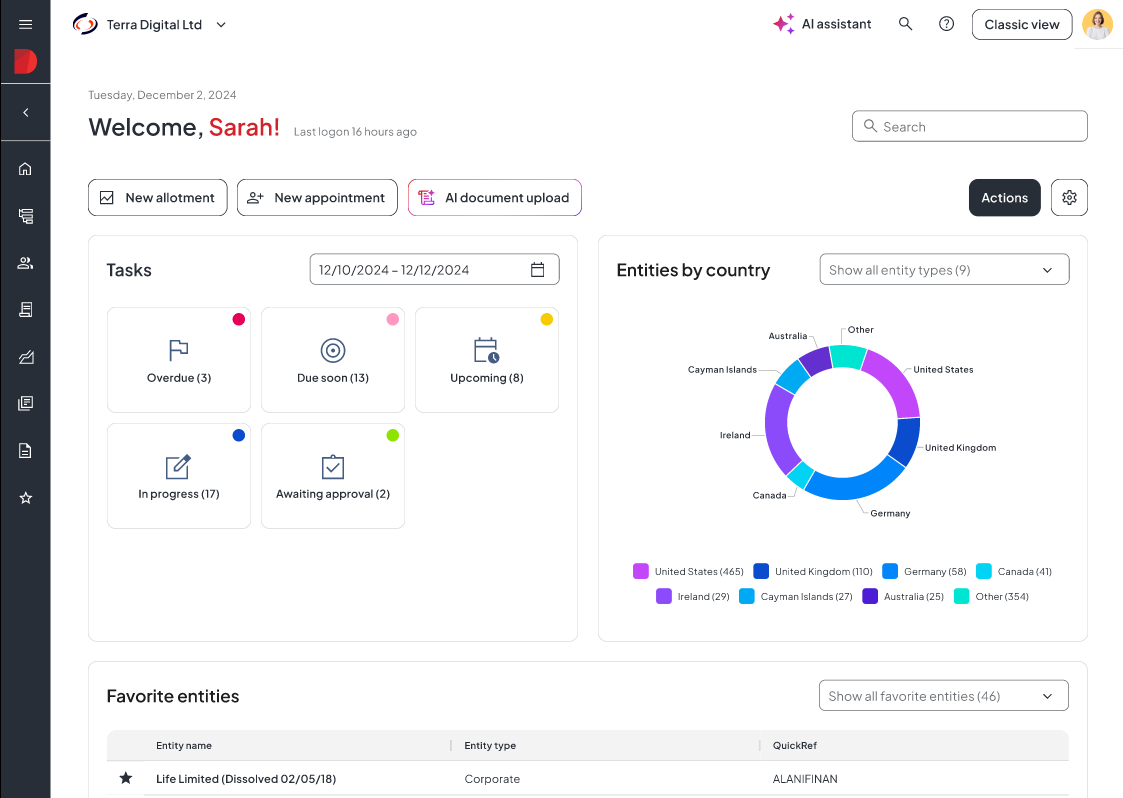
Flexible data libraries store documents and information for entities worldwide, automatically maintaining historical records and tracking changes over time. This centralized approach ensures compliance teams have immediate access to current beneficial ownership information when preparing filings or responding to regulatory inquiries.
Dedicated governance platforms provide enterprise-grade security for sensitive beneficial ownership information. Multi-factor authentication, encrypted data transmission, and role-based access controls protect confidential details while enabling authorized personnel to access information when needed.
Secure board portals facilitate communication about beneficial ownership matters without relying on email or consumer file-sharing services that lack appropriate security controls. This approach reduces security risks while maintaining the collaboration capabilities compliance teams need.
Diligent’s AI-powered risk management technology can monitor regulatory changes across multiple jurisdictions automatically, alerting compliance teams when beneficial ownership requirements change. This proactive monitoring capability helps organizations adapt to regulatory evolution, like the recent U.S. requirement elimination, while maintaining compliance in other jurisdictions.
Automated risk scanning can identify potential compliance gaps before they become violations, enabling proactive remediation rather than reactive crisis management.
Embrace strategic risk oversight with centralized data management and automated risk assessments across all jurisdictions.

Beneficial ownership compliance continues evolving across jurisdictions, but the need for accurate ownership transparency remains constant. Organizations that implement centralized systems and automated processes can manage these requirements efficiently while positioning themselves for future regulatory changes.
Ready to transform your beneficial ownership compliance burden into a streamlined, technology-enabled process? Book a demo and discover how Diligent Entities can centralize your global entity management and automate compliance across all jurisdictions.
A beneficial owner is typically an individual who owns or controls 25% or more of a company's shares or voting rights, or has significant control over the company's operations. However, thresholds and definitions vary by jurisdiction — Australia uses 25% for general companies but 20% for sensitive sectors, while some jurisdictions include influence-based criteria beyond ownership percentages.
No, domestic U.S. companies and U.S. persons are no longer required to file beneficial ownership information following FinCEN's March 2025 regulatory change. However, foreign entities registering to conduct business in the U.S. may still face reporting requirements, and regulations could change again in the future. Always discuss your organization’s specific reporting requirements with a qualified legal advisor, financial advisor or other expert.
Yes, AI-powered compliance platforms can significantly streamline beneficial ownership management across multiple jurisdictions. These platforms provide centralized record management, automated regulatory monitoring, secure information sharing, and direct filing capabilities that reduce administrative burden while improving compliance accuracy and timeliness.
Schedule a demo to see how automated entity management can simplify your multi-jurisdictional compliance requirements.