

If you're implementing an enterprise risk management program, a chief risk officer (CRO) is critical. They oversee the organization's risk management processes and understand what risks need to be identified and mitigated. But if compliance risks aren't properly assessed, the CRO may not see them until a regulatory enforcement action occurs.
A CRO is just that — focused on enterprise risks generally. They need the assistance of a chief compliance officer (CCO) and internal auditors — specialists — to get a real view of the compliance and control risks to the organization. The same principle applies to enterprise risk and compliance.
There's currently a debate about whether compliance should be subsumed into a singular risk function. The market is moving toward integrated ERM-compliance models where compliance maintains independence while its risk assessment process works in seamless coordination with enterprise risk management.
However, the execution gap remains significant — while 59% of organizations report improved coordination benefits per PwC’s Global Compliance Survey, only 16% have successfully integrated data systems, according to a Compliance Week survey.
This comprehensive guide explains the critical balance between compliance independence and risk integration, covering:
Enterprise risk and compliance teams operate as coordinated but independent functions. Enterprise risk aggregates and reports on all organizational risks to support strategic decision-making, while compliance independently manages regulatory and legal risk through specialized expertise and direct board oversight. They share data and align on risk priorities but maintain separate accountability structures.
Think of enterprise risk as the orchestra conductor and compliance as the lead violinist. The conductor needs the violinist's expertise and the violinist benefits from the conductor's broader perspective, but the violinist must maintain independent judgment about their performance.
Enterprise risk teams provide:
Compliance teams maintain:
1. Shared visibility, separate accountability: Both teams need access to the same risk information, but they use it differently. Enterprise risk synthesizes compliance data into strategic risk reporting for the C-suite, while compliance maintains detailed regulatory risk registers that require specialized interpretation.
2. Coordination without subordination: Compliance coordinates with enterprise risk without reporting through it. This distinction matters because regulators evaluate whether compliance has sufficient independence to challenge business decisions and escalate concerns directly to the board. A compliance function that reports exclusively through enterprise risk fails this independence test.
3. Integration of systems, not organizations: The teams should share technology platforms, risk taxonomies and reporting calendars. This integration enables efficient collaboration. However, organizational integration — making compliance a division within enterprise risk — compromises the independence that regulatory guidance requires and effective compliance programs demand.
Corporate compliance departments manage a critical subset of enterprise risk. These include bribery, antitrust, trade compliance, data privacy, modern slavery, conflict minerals and money laundering. The laws governing these areas carry severe consequences — fines in the billions and the imposition of corporate monitors for several years when companies act unethically.
This regulatory landscape has intensified. Beyond traditional compliance domains, organizations now face complex requirements around ESG disclosure (Corporate Sustainability Reporting Directive in the EU), AI governance and supply chain due diligence (EU Corporate Sustainability Due Diligence Directive).
These emerging areas demand specialized expertise that extends beyond general risk management capabilities.
"There needs to be collaboration between risk and the business, vertically up and down, but then also horizontally across the organization. It is absolutely essential — collaboration across risk departments. The problem is that there are silos. Risk and audit are interconnected and interdependent. Collaboration helps provide audit's perspective, their insight across company policies and procedures that help improve risk's function," says Michael Rasmussen, CEO of GRC Report.
Enterprise risk management can work effectively with the compliance function to ensure compliance risk is understood and appropriately addressed. Here are ten best practices to ensure smooth sailing.
The board, C-suite, enterprise risk management lead and chief compliance officer need alignment on risk appetite before implementing any controls. Risk appetite defines the organization's tolerance for risk — some companies embrace a "move fast" mentality while established enterprises maintain conservative approaches.
Defining risk appetite is critical for ensuring enterprise risk and compliance work with the same expectations. Strict compliance controls can slow business processes. For instance, comprehensive due diligence on high-risk third parties may delay important contracts. The board and C-suite must articulate the company's risk appetite, enabling enterprise risk and compliance functions to determine appropriate control stringency.
Globally, regulators expect companies to have compliance-specific risk assessments from which compliance programs are built. The DOJ's 2023 guidance instructs prosecutors to evaluate the effectiveness of the company's risk assessment and how the compliance program has been tailored based on that assessment. The U.K.'s Ministry of Justice requires bribery-related risk assessments to defend against strict liability offenses.
The compliance risk assessment should be separate from enterprise risk to conform to regulatory expectations. At a high level, compliance risks should appear on the enterprise-wide risk register. However, compliance should maintain a detailed risk register that feeds into the enterprise-wide one but includes specific details about risk and mitigation plans that require specialized compliance expertise to interpret and manage effectively.
Traditional periodic compliance reviews no longer satisfy regulatory expectations or business needs. Leading organizations implement AI-powered continuous monitoring that analyzes 100% of transactional data rather than relying on sampling methodologies.
Continuous monitoring enables compliance teams to identify emerging patterns, detect anomalies in real time and respond proactively to potential violations before they escalate. This shift from periodic to continuous oversight represents a fundamental transformation in how enterprises manage compliance risk at scale.
Some risks necessarily span multiple functions. Managing modern slavery and human trafficking risk often involves compliance, corporate social responsibility and procurement departments. Risks that bleed across departments must have a primary owner assigned. As the saying goes, the fastest way to starve a pet is to give everyone the responsibility to feed it.
Document these ownership arrangements explicitly. Create RACI matrices (Responsible, Accountable, Consulted, Informed) that clarify who owns risk identification, assessment, mitigation and monitoring for each cross-functional compliance domain. Review and update these assignments annually as the organization evolves.
Guidance from regulators is clear: Compliance needs an independent relationship with the board. The DOJ specifically instructs prosecutors to assess whether compliance has direct access to the board of directors or the audit committee.
Allowing enterprise risk to report exclusively on compliance risk creates communication breakdowns. No matter how skilled the enterprise risk manager, the depth of knowledge required to explain compliance risk and risk-based approaches will be missing when filtered through another function.
Compliance should always have access to and be able to report to the board. This is critical in three instances:
Many organizations now use dual reporting lines where compliance reports operationally to the CEO but functionally to the audit committee. This structure maintains independence for governance oversight while enabling effective operational coordination.
Beyond traditional compliance areas, organizations must now address:
These emerging domains require the same rigorous risk assessment and independent oversight as traditional compliance areas. Yet many organizations struggle with this integration — particularly around AI governance.
According to the Q3 2025 GC Risk Index from Corporate Board Member and Diligent Institute, while 29% of companies report having comprehensive AI governance policies and another 38% are drafting them, 44% acknowledge their policies need refinement and 33% say they're entirely insufficient.
“Organizations leading the way in compliance are leveraging technology and procedural reviews not just to meet regulatory obligations but also to strengthen their overall risk posture,” says Kristy Grant-Hart, Vice President and Head of Advisory Services for Spark Compliance, a Diligent Brand. “When companies prioritize advanced compliance tools and ongoing risk assessments, they're better equipped to anticipate regulatory changes and minimize exposure to emerging risks.”
Organizations should conduct gap assessments to determine whether existing compliance structures adequately address these evolving requirements or whether specialized resources are needed.
It's impossible to know how the controls work without testing them. Enterprise risk and compliance should work with internal audit to ensure perceived risks are explored and control failures are investigated. Compliance should champion and devise risk mitigation strategies while the internal audit team validates their implementation effectiveness.
This coordination requires regular communication and shared planning. Quarterly meetings between compliance, risk and audit leadership should review:
Enterprise risk can stay apprised of this progress while allowing compliance to be primarily responsible for such activity.
Siloed point solutions for risk, compliance and audit create integration challenges that undermine effective enterprise compliance risk management. Disparate systems lead to duplicative data entry, inconsistent reporting and gaps in oversight where risks fall between functional boundaries.
Unified GRC platforms enable collaboration through shared data, standardized risk taxonomies and integrated workflows while maintaining functional independence through role-based access controls and distinct reporting structures. This technology architecture supports the organizational principle of integrated data with independent accountability.
Discover how integrated GRC platforms enable coordination between risk, compliance, and audit functions.

Effective enterprise compliance risk management requires reporting that provides boards with clear visibility into compliance risk without overwhelming them with operational details. Board-ready reporting should:
Automated reporting capabilities reduce the time compliance teams spend compiling board materials while improving consistency and quality. Templates and dashboards should be configured to answer the questions boards actually ask rather than providing generic compliance status updates.
Organizations should track:
These metrics should inform continuous improvement efforts rather than serving solely as reporting statistics. Quarterly reviews of compliance metrics should drive discussions about resource allocation, program enhancements and emerging risk priorities.
For organizations managing complex regulatory requirements across global operations, integrated governance technology addresses the coordination and independence challenges documented throughout this guide.
Diligent ERM provides enterprise-grade risk management with AI-powered risk identification that benchmarks against 180,000+ real-world risks from SEC filings and Moody's risk intelligence.
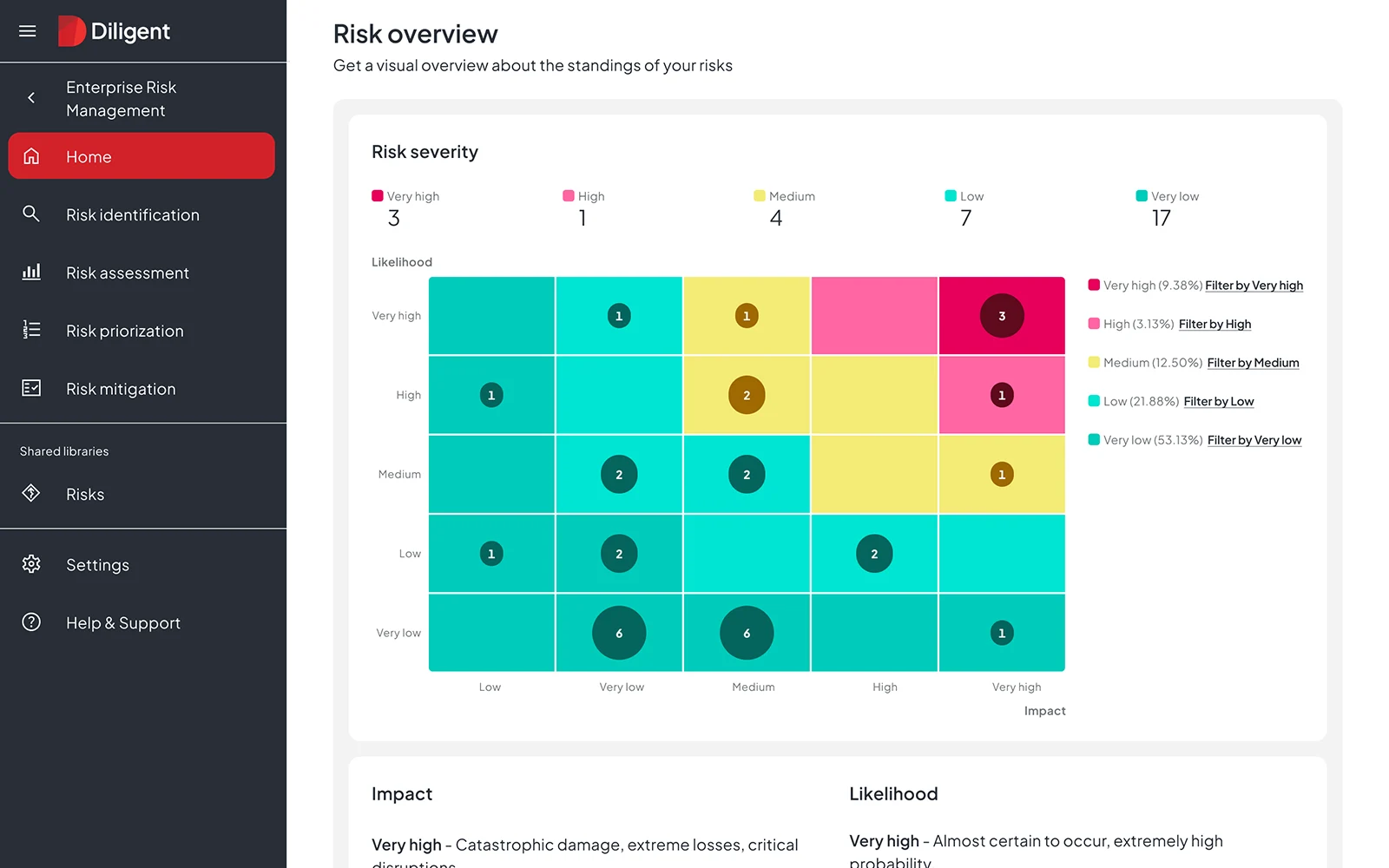
The platform enables comprehensive risk orchestration across business units and geographies while maintaining clear accountability structures. FedRAMP authorization and DoD IL5 certification support organizations with stringent security and compliance requirements.
Regulatory Compliance Management through Diligent combines AI-powered compliance assistance with Regology's continuously updated regulation library. The AI compliance assistant analyzes regulatory changes, identifies key requirements and suggests mitigating controls — addressing the regulatory monitoring burden that enterprise compliance teams face across multiple jurisdictions.
The Diligent One Platform unifies these capabilities into a single GRC ecosystem, eliminating the integration challenges created by disparate point solutions. Board-ready reporting templates deliver consolidated views of risk and compliance to directors while maintaining the detailed audit trails that regulators expect.
This integrated approach supports independent compliance accountability enabled by unified data and coordinated workflows. Organizations achieve the collaboration benefits of integration without compromising the independence that regulators require and effective compliance programs demand.
Ready to transform your enterprise compliance risk management? Schedule a demo to see how Diligent can help.
Enterprise risk management encompasses all risks to organizational objectives, including strategic, operational, financial and compliance risks. Compliance risk management focuses specifically on regulatory and legal risks requiring specialized expertise in laws governing bribery, antitrust, data privacy, trade compliance and similar domains.
While compliance risk is part of enterprise risk, it requires independent oversight and specialized assessment methodologies to satisfy regulatory expectations.
Best practice involves dual reporting structures. Compliance should report operationally to the CEO or chief risk officer for day-to-day coordination while maintaining functional reporting to the board's audit committee for governance oversight.
This structure enables operational efficiency while preserving the independence that regulators like the DOJ require when evaluating compliance program effectiveness.
Unified GRC platforms enable integration through shared data, standardized risk taxonomies and coordinated workflows while maintaining independence through role-based access controls, distinct reporting structures and separate risk assessment processes.
Organizations achieve collaboration benefits without organizational consolidation that could compromise compliance independence.
Beyond traditional compliance domains, enterprises should prioritize AI governance, ESG disclosure requirements (particularly CSRD in Europe), cyber resilience and supply chain due diligence. The EU's Corporate Sustainability Due Diligence Directive and the increasing focus on AI regulation create new compliance obligations that require specialized expertise and integration with broader risk frameworks.
Explore how Diligent's unified GRC platform can support your enterprise compliance risk management transformation. Request a demo today.





