

In this article

In public sector audit, updates to OMB Circular A-123 — and increased scrutiny overall — have made traditional oversight a thing of the past.
As the volume of data continues to grow exponentially, labor-intensive processes for data collection and review fall woefully short. Point-in-time controls testing lacks the continuous view required by today’s fraud, waste and abuse landscape. When an issue does arise, disconnected email chains are difficult to transform into efficient next steps or a unified, defensible history for reporting.
In short, public sector audit is undergoing a sea change, from manual to modernized, reactive to proactive. Navigating it requires an equally fundamental shift, with audit teams learning to incorporate tools like automation, analytics and AI into their work while continuing their important oversight of public expenditures, benefits and services.
How well are they keeping up? We asked the leaders who live with these challenges every day, including auditors, analysts, controllers and more.
Here’s what they told us.
A full half of respondents classified their program as “very strong,” meaning that they perceive their internal controls to be well-documented and regularly tested.
Yet this leaves another half lacking such critical confidence. A not-insignificant 38% called their programs “mixed,” with some areas well-controlled but others not.
Top challenges included keeping control documentation up to date and managing controls across multiple systems.
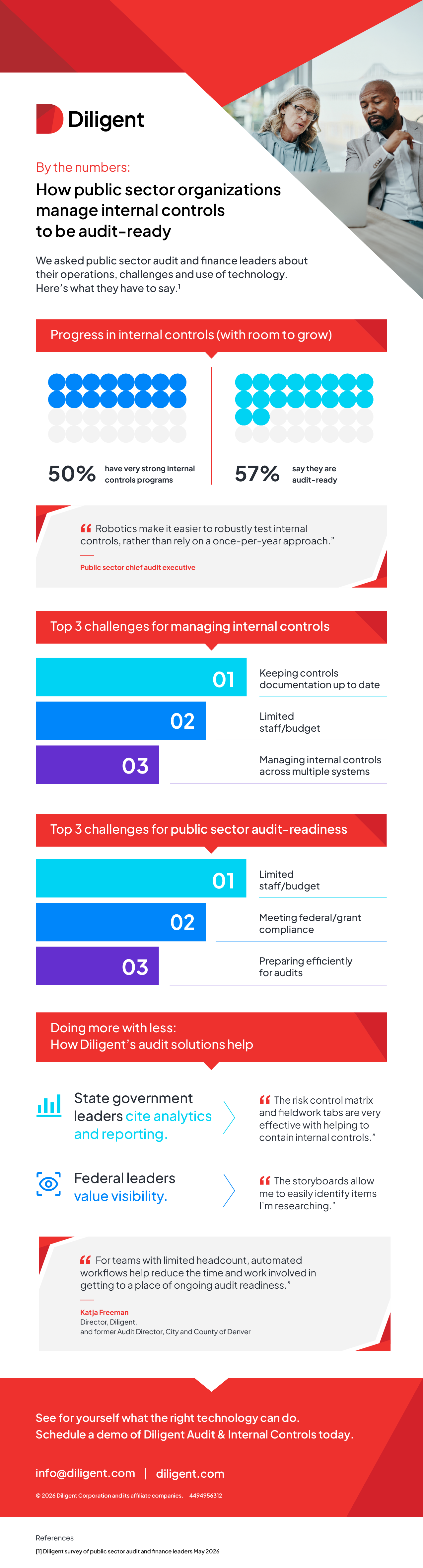
Download the infographic in PDF format here.
An agency or school leader seeks a progress report on outstanding issues. A state regulator requests a review. In addition to maintaining their own oversight for risk and internal controls, public sector audit teams need to be audit-ready for external stakeholders, without diverting time and energy away from other important work.
Efficient preparation ranked as a top challenge. So did the work involved in grant compliance requirements.
Over half of the public sector leaders we heard from described their audit readiness as “very strong.” Strength, however, is relative.
One out of every four said their processes preparing for reviews “could do with some streamlining.” Over 10% called their workflows “manual and time-consuming.”
“We are always looking at ways to improve internal controls and making our work processes efficient and less time-consuming,” shares one state auditor.
In federal, state and local agencies, as well as higher education institutions, many leaders cited a lack of headcount, along with budget being in short supply.
Nearly 4 out of 10 (38%) of the public sector audit leaders we heard from said staff and budget limitations keep them from being as audit-ready as they want to be. A quarter of them said this also limits their internal controls efforts.
“We are always looking at ways to improve internal controls and making our work processes efficient and less time-consuming.” - State Auditor.
Purpose-built audit solutions can be a game-changer for cost-effectively achieving such efficiencies. Think unified hubs for monitoring and controls, automation- and analytics-powered continuous controls monitoring and AI-assisted testing and documentation — all brought together with leadership-ready reports and dashboards.
But bringing these capabilities into everyday operations can feel easier said than done. One leader cites “the pace at which technology is changing” among her biggest challenges.
The encouraging news: public sector audit teams are facing these challenges head-on through the strategic adoption of new innovations.
We asked users of Diligent Audit & Internal Controls which features they find most useful for managing internal controls and being audit-ready.
Leaders from state government called out analytics and reporting. “The risk control matrix and fieldwork tabs are very effective with helping to contain internal controls,” says one state auditor.
Their counterparts on the federal side value visibility. “The storyboards allow me to easily identify items I’m researching,” shares one finance leader.
Finally, leaders across public sector audit are already seeing major benefits from automation, AI and analytics, especially for continuous controls monitoring.
“Robotics makes it easier to robustly test internal controls, rather than rely on a once-per-year approach,” says one chief audit executive.
“Using the Diligent software, our staff can jump right into projects pretty quickly and get things done,” declares another director of audit.
Diligent Audit & Internal Controls gives public sector organizations a technology solution to automate, design, test and monitor controls, while keeping audits, findings and remediation in one defensible workflow.
With connected controls, analytics and case management, teams can continuously test for fraud, waste and abuse while proving compliance with relevant frameworks and walking into every review audit-ready.
See for yourself what the right technology can do. Schedule a demo of Diligent Audit & Internal Controls today.

Stronger public sector controls start with Circular A-123

Recent updates to OMB Circular A-123 elevate the importance of internal controls within federal agencies, emphasizing a more proactive, risk-informed approach to managing fraud, waste, and abuse. This shift not only affects compliance but also presents a unique opportunity for agencies to enhance their control systems and risk governance through continuous controls monitoring (CCM). Discover how these changes can empower public sector financial managers to improve oversight and accountability while leveraging modern technology.

5 steps for introducing audit software into public sector organizations
This technology guide details five actionable steps for software integration to help your public audit team accomplish more in less time, building the value of audit, fostering executive alignment and creating relevance to your executive leadership.




